
Before you buy a car, plan a swap, or argue with someone on a forum, it helps to know what is actually bolted under the back of your MX-5. There are a handful of types fitted across the range and four common ratios, and you cannot always tell from the spec sheet because cars get swapped about over thirty years. Here is how we work it out on the car, with nothing more than a couple of marks and one driveshaft out.
This works on any Mk2 or Mk2.5, where every type shares the same casing, and on a push-in-shaft Mk1.
What the MX-5 came with
- Open. No limited slip, one wheel can spin on its own. The base car, any generation.
- Viscous LSD (VLSD). A sealed unit with a silicone fluid that thickens when one wheel spins. This is the Mk1 1.6 limited-slip diff, and only that car. There is no bar to see through the hole, so it is spotted a different way, by its unequal-length stub axles.
- Tochigi Fuji clutch-type LSD, the "Super LSD". A clutch pack that ties the two sides together. This is the factory clutch-type unit fitted from 2003 on the naturally aspirated Mk2.5. Earlier limited-slip 1.8s ran a Torsen instead, but the Super LSD shares the same case and drops straight in, so it turns up in earlier cars too. The plates wear with age, so a tired one is worth rebuilding or replacing the centre.
- Torsen LSD. Parallel helical gears that bias torque to the wheel with grip, with no clutches and no fluid to wear out. Fitted to 1.8 and special-edition cars, in a Type 1 and a later Type 2.
One naming trap worth clearing up: "Fuji" is just the maker, Tochigi Fuji Sangyo, who built the viscous, the clutch-type and the Torsen units for Mazda. So it pays to name the type, not the brand. The Torsen is the one most people are chasing, but you need to know what you have before you know what you are missing.
Step 1: Find the ratio
You can read the ratio off the car without opening anything, just by counting turns.
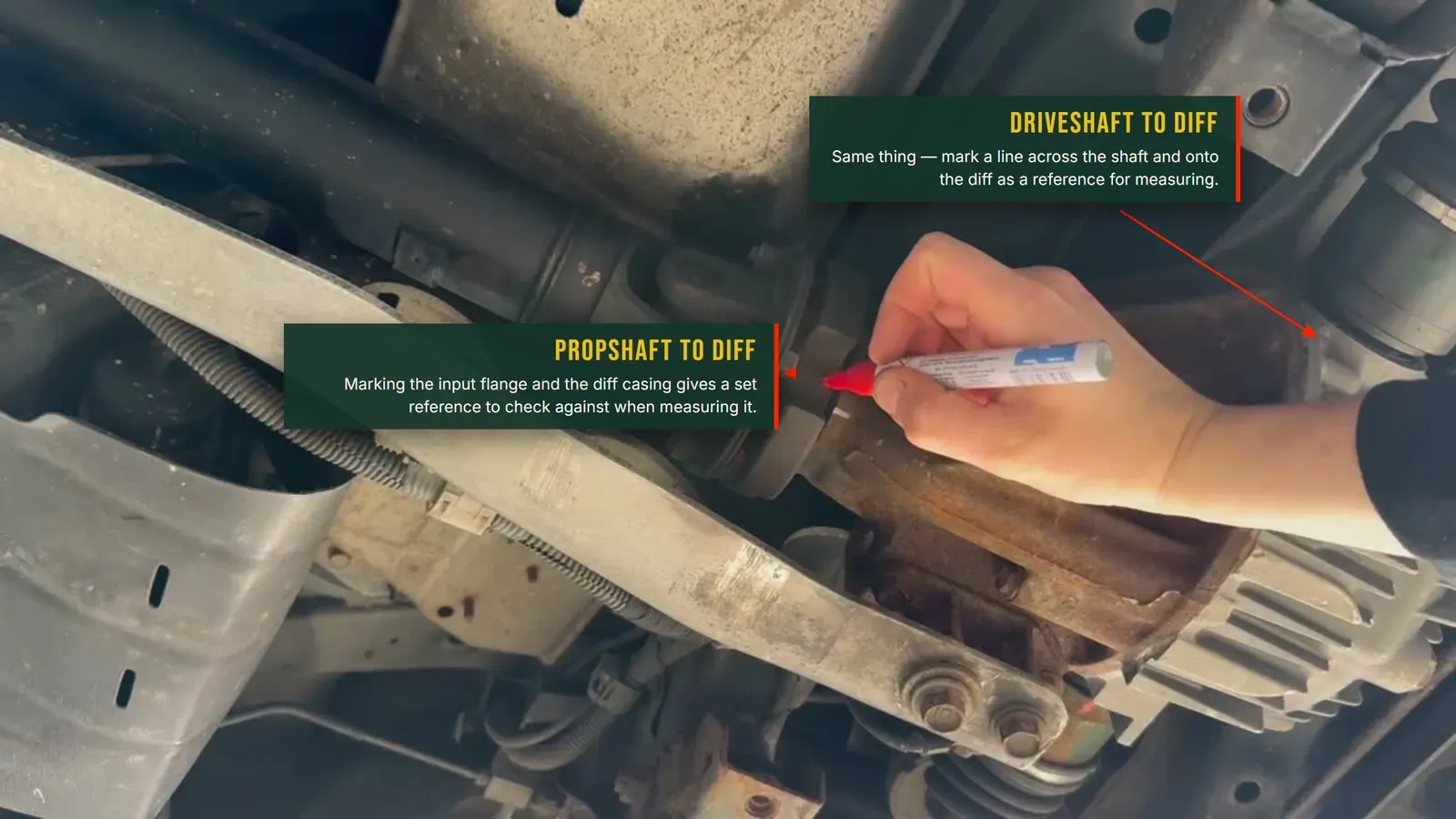
- Mark the half-shaft (the driveshaft) so you have a reference point, and mark the prop shaft and the nose of the diff.
- Rotate the prop shaft and count the turns it takes for the half-shaft to go round exactly once.
- It will be about four turns. Where the mark lands is the answer. A hair past four turns is a 4.1, a third of a turn past is a 4.3, a touch short of four is a 3.9, and well short of four is a 3.6.
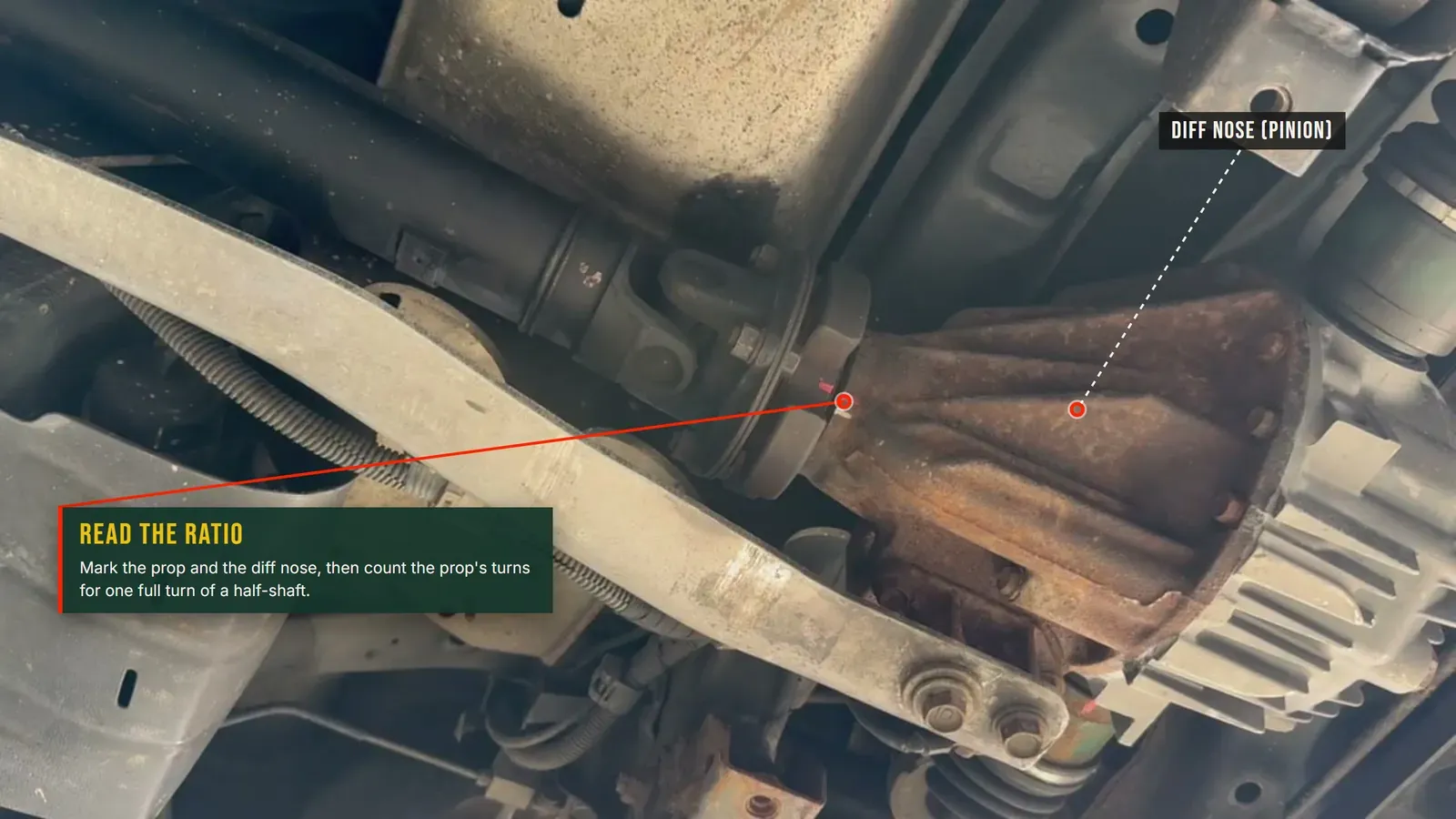
That gives you the ratio without taking a single bolt out. Now for the type.
Step 2: Find the type
For this one you take a single driveshaft out so you can see into the diff.
- Wheel off. Take the brake caliper and carrier off the hub and hang them up so you are not straining the brake lines. It makes the next part much easier.
- On an ABS car, take the ABS sensor out of the top of the hub, because the hub is going to lean forward.
- Undo the hub nut.
- Knock the driveshaft free from the hub, not the diff. A soft-faced or copper hammer on the end of the shaft drives it back out of the hub splines. Do this while the arm is still bolted up, so everything is held tight, the blow lands cleanly and nothing moves about. Once it is free of the hub, move on.
- Remove the top arm bolt, the one that bolts the upper arm to the top of the hub.
- With the top arm free of the hub, loosen the bottom arm bolt and lean the hub forward. That lets the outer end of the shaft come out of the hub entirely. Push it aside, clear of the hub, with the other end still in the diff.
- Finally, lever or knock the shaft out of the diff. It is held by a circlip, so it pops when it frees, then draw it out of the diff and the car. With the car level no oil follows it, the shaft sits below the diff’s fill level; if it is not level, drain the diff first.
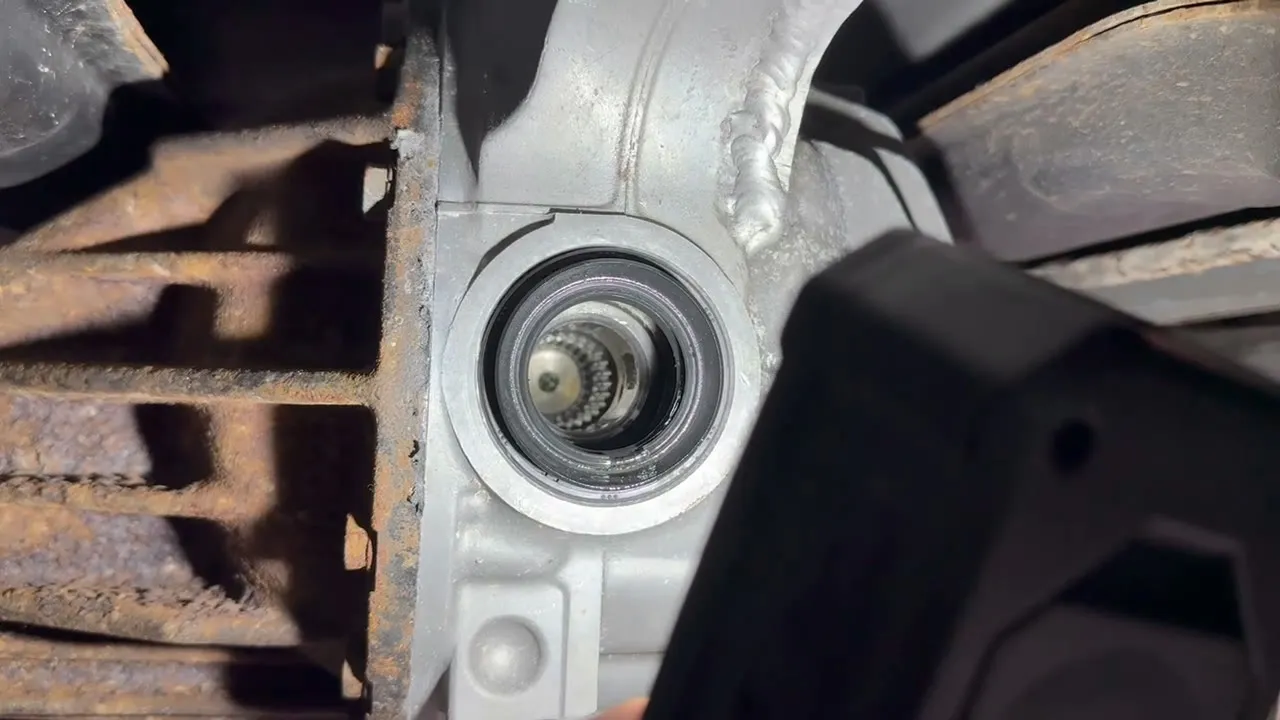
Now look into the diff where the shaft came out, and read the internals:
- A round bar across the middle means an open diff.
- A hexagonal bar across the middle means a Tochigi Fuji clutch-type LSD. Open and Fuji both put a bar across the centre, so look at the shape: round is open, six-sided is the Fuji.
- A clear view straight through to the other driveshaft means a Torsen Type 1.
- A narrow hole with a washer-style disc in the way means a Torsen Type 2.
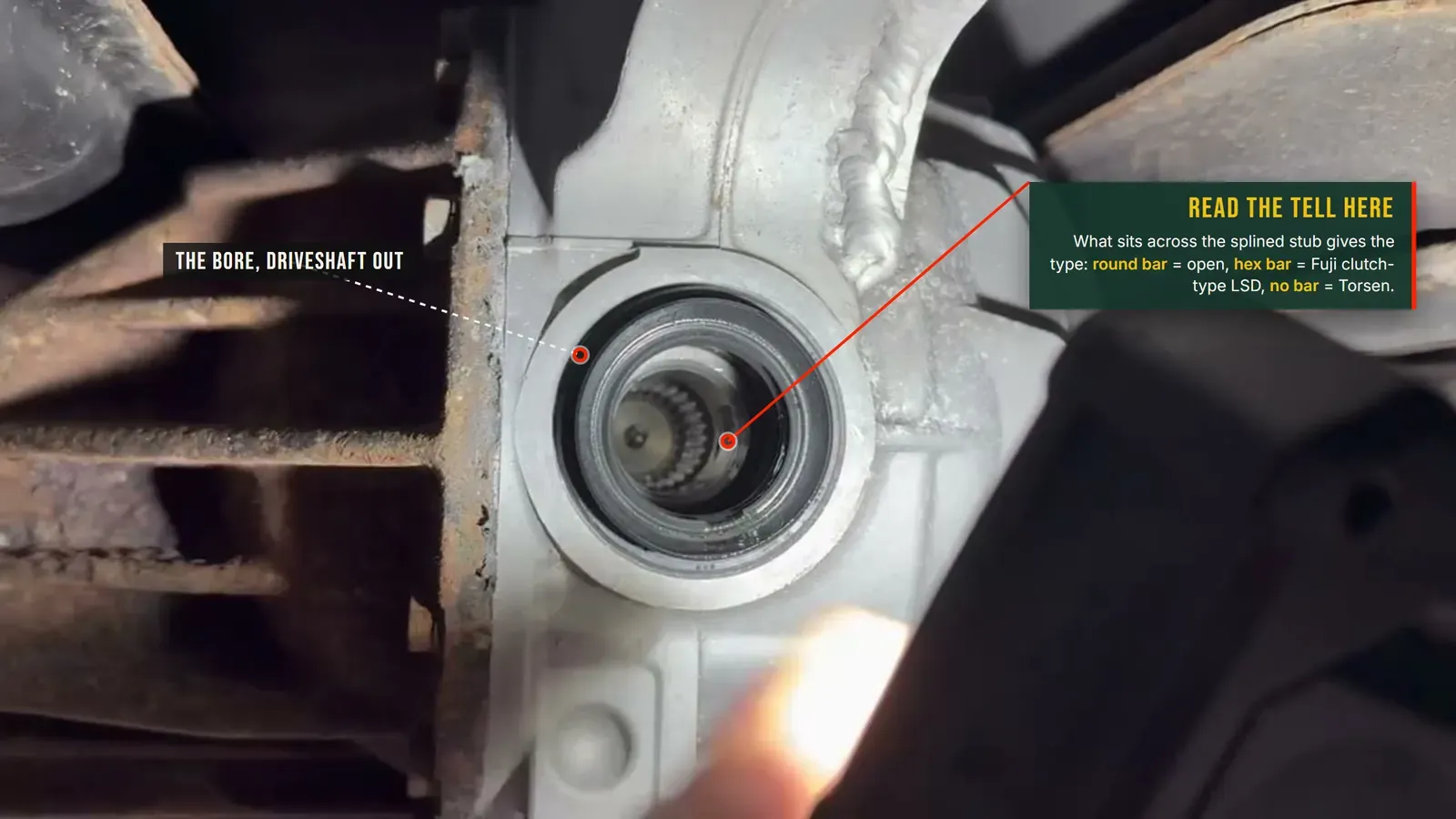
That is your answer. Ratio from the turns, type from the hole. You will not find a viscous this way on a Mk2, that one only lives in the Mk1 1.6. The 1.6 runs the smaller-case diff, and you spot it from the outside by its unequal-length stub axles rather than through the hole.
The spin-a-wheel test, and why we don’t trust it
You will read that you can jack both rear wheels off the ground, spin one by hand, and tell an open diff from an LSD by which way the other wheel turns. Be careful with it. An LSD does not lock under that little load, so off the ground with no weight on it, an LSD can spin just like an open diff and send the other wheel the opposite way. When it does lock it tells you something, but when it does not lock it does not prove the diff is open, so it is not a definitive answer. If you need to know for certain, read the type from the hole as above.
Putting it back
Once you know the ratio and the type, it goes back together in reverse: shaft back into the diff until the circlip clicks home, hub back, driveshaft into the hub, hub nut and bolts up, ABS sensor and caliper back on. Top the diff oil back up to the level plug with 75W-90, adding a friction-modifier additive if it is the clutch-type Fuji, and you are done.
Torques
These are the fasteners this job asks you to undo, in the order you meet them. Figures are the Haynes OEM values for the 1989 to 2005 cars, cross checked against Autodata, and the two agree on every one.
| Fastener | Torque |
|---|---|
| Road wheel nuts | 110 N·m (81 lb-ft) |
| Rear caliper carrier to hub | 50 N·m (37 lb-ft) |
| Rear caliper guide pin bolts | 50 N·m (37 lb-ft) |
| ABS wheel sensor bolt | 20 N·m (15 lb-ft) |
| Hub nut, 1997 and earlier | 255 N·m (188 lb-ft) |
| Hub nut, 1998 on | 275 N·m (203 lb-ft) |
The hub nut is a single use nut. Fit a new one, do not re-use the old one however good it looks, and do not guess it: at 275 N·m this is the tightest fastener on the back of the car and it is what holds the wheel bearing together.
One thing to watch if you are working at the front as well. The front caliper is not the same as the rear. Its carrier bolts are 65 N·m, and its guide pins are 50 N·m except on the 270 mm discs, where they are 26 N·m.