
When you wire in a standalone, chase a no-start, or adapt a loom onto a different car, the first thing you need is the factory ECU pinout: which cavity is which pin, what each pin does, and what colour the wire is. Mazda made this awkward, so we drew our own.
Every generation has its own page, and each sheet is a FOJI original drawn to the real connector face. The Mk1 and Mk2 sheets come off donor plugs and ECUs on the bench, bar the NA8: no NA8 plug has been photographed, so its face is drawn on the NB1 face and the sheet says so. The Mk3 and Mk4 sheets are read off the Mazda factory PCM connector figures and checked against the factory terminal tables. The engine-bay diagnostic box is a separate connector with its own note.
Read this first
Wire colours change between year builds and between markets, and the Mk2, Mk2.5, Mk3 and Mk4 colour tables are read from the UK factory wiring diagrams and the Mk1 tables from the factory US diagrams. Treat a colour as a starting point, take the cavity map and the function as the reference, and ring every pin out on your own car before you cut, crimp or trust it.
How to read the sheets
Every plug is drawn looking into the ECU or PCM header, which is the same view as the wire side of the harness plug, so the sheet lines up with what you see when you back-probe. Pin A is ringed in red as the anchor. It sits top-right on every sheet bar the ND1 60-way, where the top-right cavity does not exist and 2A sits at the right-hand end of the strip below. Find a known pin first, usually the 12V feed or a ground, and use it to confirm left from right before you count across. The plug in your hand, mating face towards you, reads as a mirror of what is drawn. Each cavity is tinted by what the pin does:
By generation
Pick your car. Each page carries that generation’s sheets full size, its PDFs for the bench, what the ECU or PCM is, and what is still to confirm.
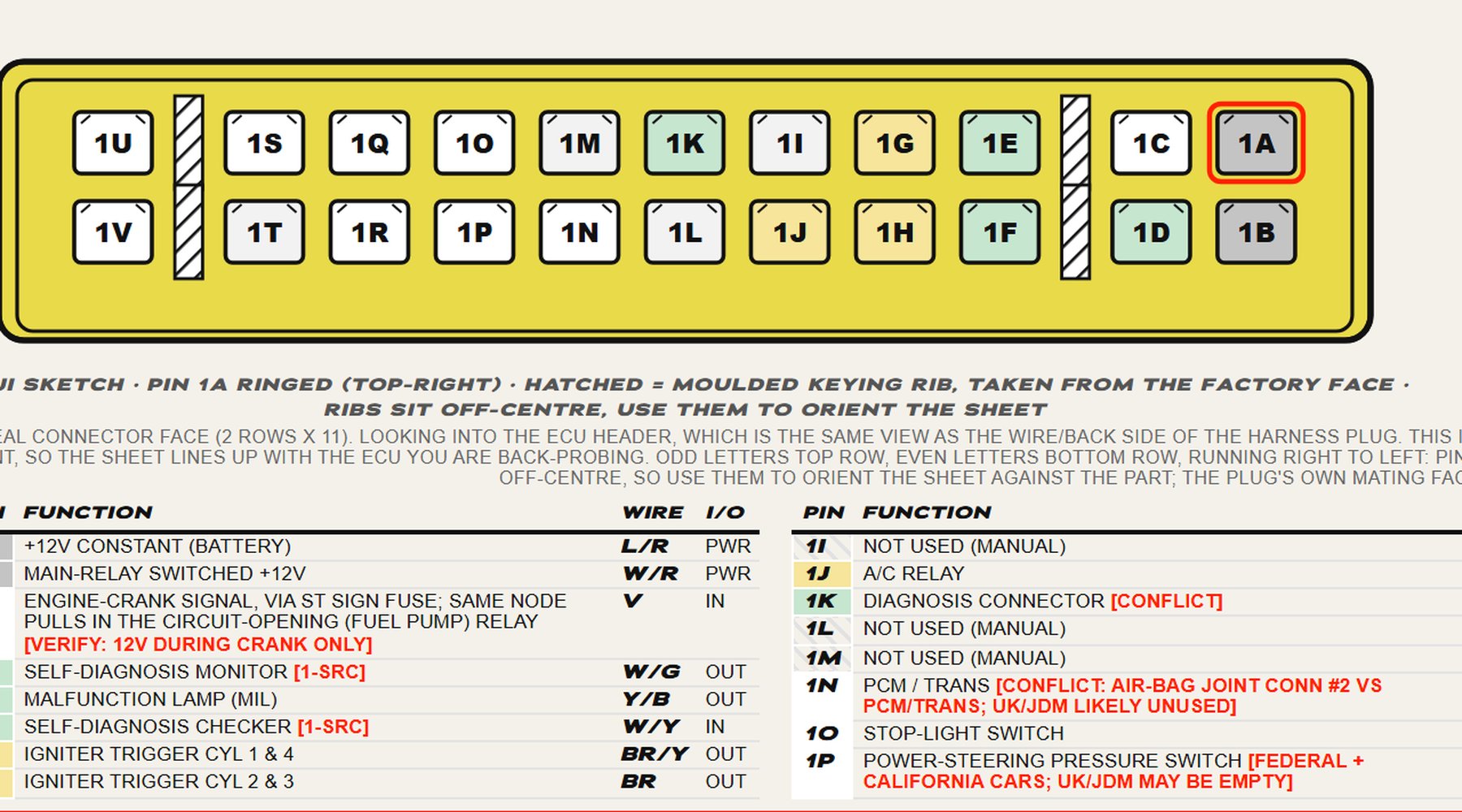 1989 to 1997
Mk1 · NA
Three sheets, the early 1.6, the 1994 to 1995 cars and the OBD-II NA8, confidence high on the 1994 to 1995 sheet and medium on the other two.
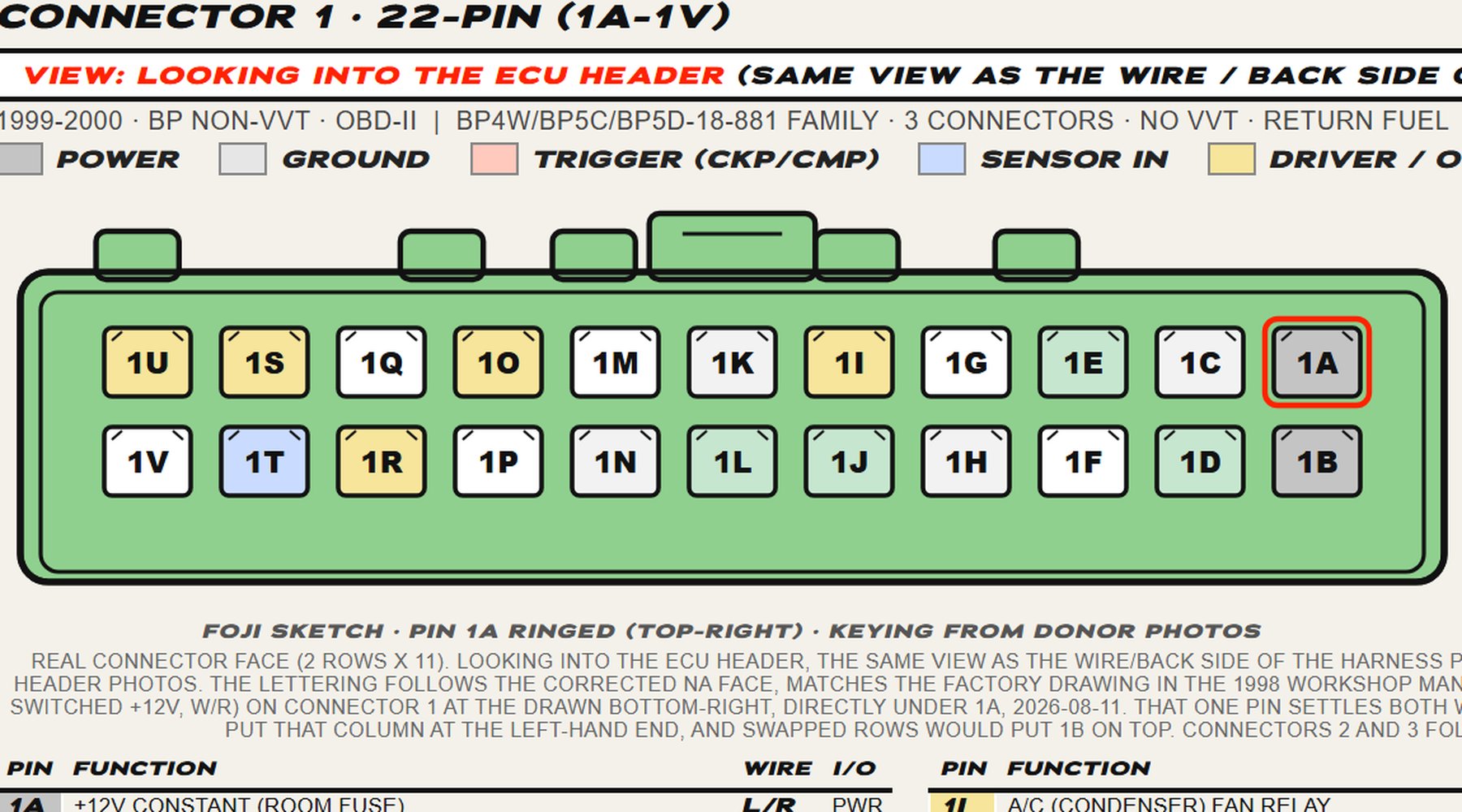 1999 to 2005
Mk2 · NB
The NB1 and the NB2 VVT sheets, both OBD-II, three connectors each, confidence high on both.
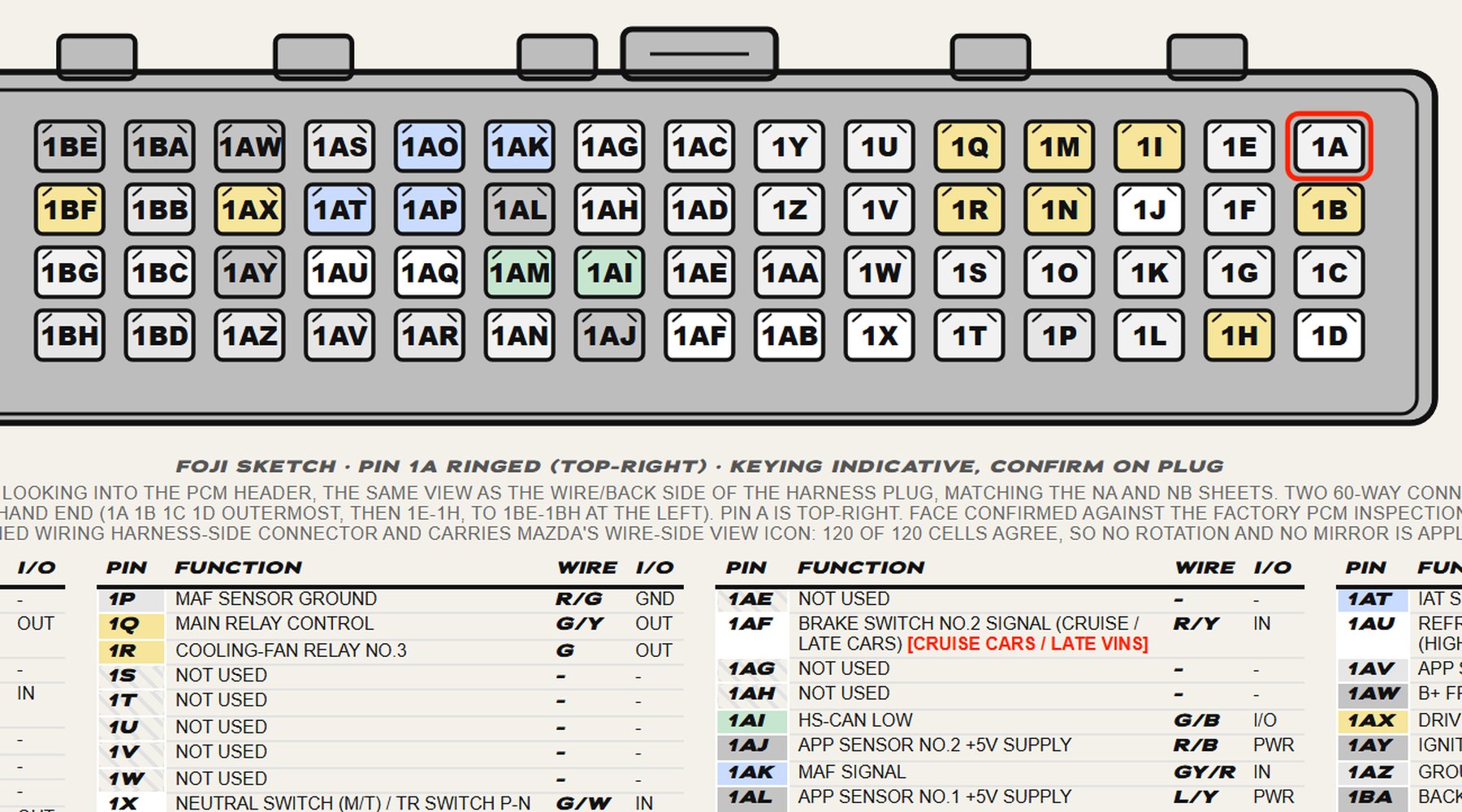 2006 to 2015
Mk3 · NC
One sheet, drive-by-wire and CAN, two 60-way connectors and 120 terminals, confidence high.
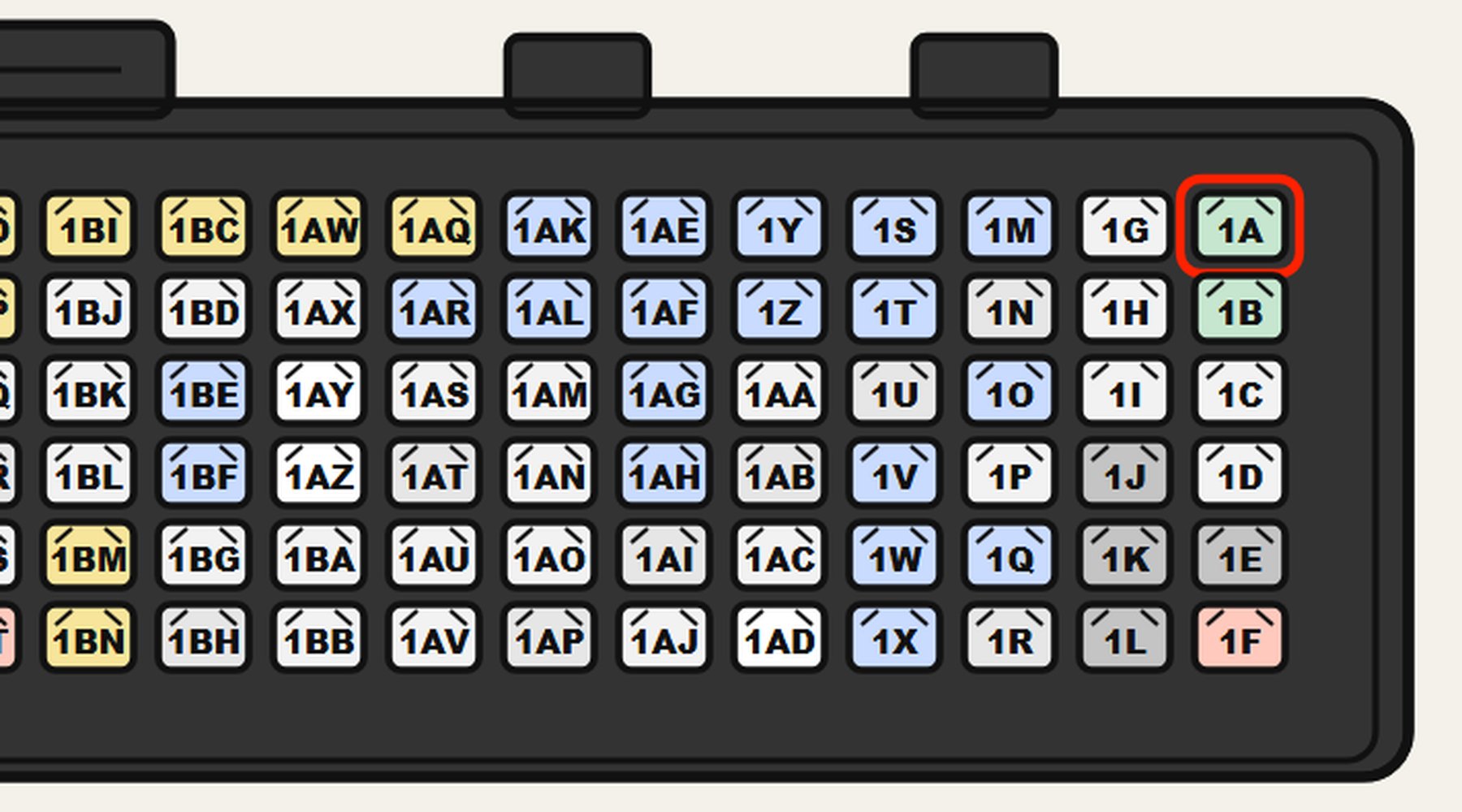 2015 on
Mk4 · ND
Two sheets, one per PCM, split by build number rather than by engine, confidence high on both.
ND build numbers 300001 to 649999 have no factory terminal table on file. The Mazda wiring for that band prints later PCM pin letters, so a middle car is on the later plug and the Mk4 ND2 sheet is the one to read.
Rotary sheets
Two rotary sheets are drawn to the same standard. They are not MX-5, the same verify-on-car rule applies, and Autodata publishes no rotary, so there is no second publisher behind either set of colours.
RX-8 · SE 13B-MSP
2003 to 2012
RENESIS 13B-MSP, VIN JMZ SE173*** 300001 on. Denso PCM, two 60-way connectors, 120 terminals, drive-by-wire, CAN, immobiliser.
The late car only: the early carline, VIN 100001 to 299999, runs a different five connector PCM lettered 1A to 5AF and is not drawn here, and with nothing rung out on a car and no RX-8 donor plug the housing keying is undrawn.
Download this sheet (PDF, A4)RX-7 · FD 13B-REW
1992 to 2002
13B-REW sequential twin turbo, VIN JMZ FD13B200 300001 on. Mazda EGI control unit, 22 plus 12 plus 16 plus 26 way, 76 terminals, OBD-I self-diagnosis.
- Connector 1, 22-pin (1A to 1V), front harness
- Connector 2, 12-pin (2A to 2L), front harness
- Connector 3, 16-pin (3A to 3P), engine member harness
- Connector 4, 26-pin (4A to 4Z), engine member harness
Three cells disagree between sources and the sheet carries both values on the row, 1E, 3J and 4E, and with nothing rung out on a car and no RX-7 donor plug the housing keying is undrawn.
Download this sheet (PDF, A4)